

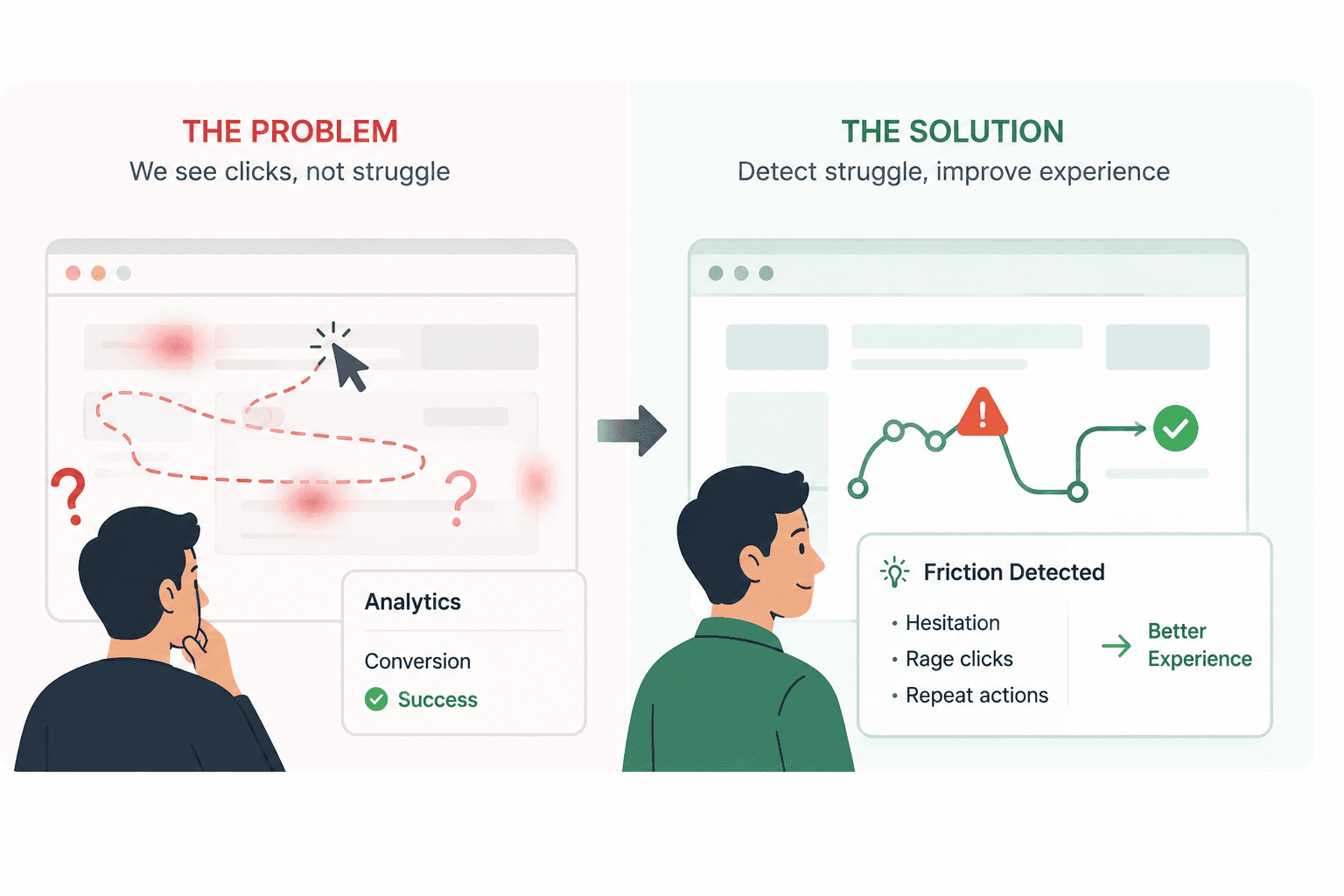
Traditional page analytics and clickstream analysis are no longer enough for modern digital products. Businesses today need deeper visibility into user behavior, hesitation patterns, frustration signals, and cognitive overload.
This is where Friction Intelligence is becoming one of the most important emerging concepts in product analytics. Modern analytics platforms can now help businesses detect hidden user struggle in real time using behavioral analytics, event streaming, and intelligent session analysis.
Introduction
In this article, we explore why traditional analytics often miss critical UX problems, what Friction Intelligence actually means, how companies can implement it using modern analytics architecture, real-world use cases, and why this approach is becoming the future of product analytics.
Why Traditional Analytics Is No Longer Enough
Most analytics systems today are designed to answer one question: “What did the user click?” But modern product problems rarely happen at the click level.
Users struggle in much subtler ways. They hesitate, get confused, repeatedly compare options, pause before important actions, rage-click broken experiences, and abandon flows after cognitive overload.
The biggest problem? Traditional analytics platforms often mark these sessions as successful — even when the experience was frustrating.
The Hidden Problem Most Companies Don’t Measure
A user eventually completes checkout. Your dashboard shows conversion successful. But what actually happened?
- 📈 The dashboard records a successful conversion.
- 🔁 The user reopened pricing five times.
- 🖱️ They hovered repeatedly on tooltips.
- ⏱️ They paused twenty seconds on the payment form.
- 📋 They copied coupon codes from another tab.
- 🔀 They changed plan multiple times.
- 😤 They rage-clicked a disabled button.
- ❓ They revisited FAQs repeatedly.
Your analytics captured the conversion, but it completely missed the friction. And friction is where revenue leakage begins.
The Next Evolution: Friction Intelligence
The next generation of analytics is moving beyond page views, event counts, and funnel completions toward behavioral friction detection, hesitation analysis, cognitive load measurement, intent signals, and real-time session frustration scoring.
- ❌ Page views, event counts, and funnel completions alone
- ✅ Behavioral friction detection and hesitation analysis
- ✅ Cognitive load measurement and intent signals
- ✅ Real-time session frustration scoring
This shift is called Friction Intelligence.
What Is Friction Intelligence?
Friction Intelligence is the process of detecting hidden user struggle signals during live product interaction. Instead of only measuring outcomes — for example, that a user clicked Upgrade — modern systems measure how difficult it was for the user to reach that decision.
Real Behavioral Signals Modern Systems Can Detect
⏱ Hesitation Signals
- Long pauses before actions
- Repeated field edits
- Hover indecision
- Delayed confirmations
😤 Frustration Signals
- Rage clicks
- Rapid repeated taps
- Error loops
- Excessive retries
🧠 Cognitive Load Signals
- Repeated FAQ visits
- Frequent plan switching
- Multi-tab comparison behavior
- Complex navigation loops
🔁 Recovery Patterns
- Returning after a failed attempt
- Device switching
- Session continuation
- Re-entry after abandonment
Why This Matters
Most product teams optimize after churn. Friction Intelligence allows teams to optimize before churn happens — and that changes everything.
- Predict abandonment earlier with live struggle signals.
- Trigger contextual guidance when hesitation spikes.
- Simplify experiences dynamically based on friction scores.
- Alert product teams instantly when sessions degrade.
- Personalize onboarding in real time from behavioral context.
A Real Architecture That Companies Can Implement Today
This is not theoretical anymore. Modern event-streaming systems make Friction Intelligence completely achievable at production scale.
Example Architecture
Frontend Behavioral Events
           ↓
Lightweight Event Pipeline
           ↓
Real-Time Stream Processing
           ↓
Friction Scoring Engine
           ↓
Product Intelligence Layer
           ↓
Alerts / UX Optimization / AI Models
Example Behavioral Event Payload
{
  "event": "pricing_plan_switch",
  "userId": "u_9821",
  "sessionId": "s_12093",
  "timestamp": 1746919200,
  "metadata": {
    "planChanges": 4,
    "hoverDuration": 18,
    "faqVisits": 3,
    "retryAttempts": 2
  }
}
This data can immediately indicate high decision friction before the user abandons the flow.
Example Friction Score Logic
function calculateFrictionScore(session) {
  let score = 0;
  score += session.rageClicks * 5;
  score += session.formRetries * 3;
  score += session.longPauses * 2;
  score += session.planSwitches * 4;
  return score;
}
Simple scoring systems like this already create powerful UX insights without waiting for quarterly funnel reviews.
What Makes This Different From Traditional Analytics?
- Traditional Analytics — Measures clicks | Friction Intelligence — Measures struggle
- Traditional Analytics — Reactive insights | Friction Intelligence — Predictive insights
- Traditional Analytics — Conversion-focused | Friction Intelligence — Experience-focused
- Traditional Analytics — Dashboard reporting | Friction Intelligence — Behavioral intelligence
- Traditional Analytics — Static reporting | Friction Intelligence — Real-time adaptation
Real-World Applications
🛒 E-Commerce
Detect hesitation before cart abandonment and intervene while the shopper is still in the flow.
💳 Fintech
Identify trust hesitation during payment flows before failed transactions pile up.
📦 SaaS Platforms
Detect onboarding confusion before churn and guide users through high-friction steps.
📱 Mobile Apps
Understand frustration points during navigation, permissions, and form-heavy screens.
🎥 Streaming Platforms
Detect recommendation dissatisfaction patterns and content-discovery friction in real time.
The Most Interesting Part
Most companies already collect enough raw events to build this. The missing piece is not data — it is behavioral interpretation. That is the real future of analytics.
Technologies Quietly Enabling This Shift
Modern stacks making Friction Intelligence possible at scale include:
- Apache Kafka
- ClickHouse
- PostHog
- Segment
- RudderStack
- Snowflake
- BigQuery
- Apache Flink
- Real-time WebSocket streams
These systems now allow real-time behavioral intelligence at scale without rebuilding your entire data platform from scratch.
Final Thoughts
The next decade of analytics will not be about counting more events. It will be about understanding hesitation, uncertainty, confusion, intent, trust, and cognitive load.
Users rarely leave products instantly. They struggle silently first. The companies that learn to measure that struggle in real time will build dramatically better digital experiences.
🚀 The future isn’t click analytics. It’s Friction Intelligence.
Written by BlackPotato — building modern data-driven digital experiences with intelligent analytics and scalable engineering.